Showing posts with label peugeot. Show all posts

Tuesday, December 29, 2020

Anatomy of a Peugeot plane

Few days ago, I received an email from Simon living in Netherlands about the dimensions of one of my Peugeot plane. Simon got a Peugeot blade assembly and wants to build the plane that goes along. So I made some pictures and drawings with measurements and here is the anatomy of a Peugeot plane.

Introduction


Peugeot 48


The plane is a Peugeot 48 (what is also the blade width measured in mm) and is made with Cormier wood (French naming) or Service Tree in English. For the naturalists, its scientific name is Sorbus Domestica.

Its length is about 93/8 inches (or about 238mm) what makes it a smoother plane.

Its particularity is the mechanism to move the blade.
Blade assembly, top view
Blade assembly, side view


I tried to be as precise as possible in my measurements, in inches as well as millimeters, but there may be some small deviations.

Side view

The picture below shows the side view of the plane wooden body (blade assembly and wedge removed).

Plane body, side view.

Below is a drawing with all the dimensions I was able to measure.

Plane body side dimensions.

One thing that surprised me is the 80 degrees angle of the front side of the mouth that I believed was vertical but is not.

Top view

Below is a picture of the plane body top view.


Plane body, top view

Note the notch in the blade bed that receives the adjustment screw mechanism.
Below are the corresponding dimensions on a drawing.

Plane body top dimensions

About the wedge

Below are two pictures of the plane wedge. Sorry for the shadow but I have no professional studio light so this as the best I could do.

Wedge, top view
Wedge, side view


Finally below is a drawing of the same views with the corresponding dimensions.

Wedge dimensions

Hope this will help, and if anybody is making a clone of it, please send me a picture.

Monday, December 2, 2019

Peugeot Freres Plane

A while ago my father brought me a Peugeot Freres plane from France that I did not restored yet, well until this last weekend.

Peugeot Freres plane.

This plane is made of Cormier wood (Sorbus Domestica) and it is stamped on the plane. From the stamp on one side of the plane this is a 48mm plane.

Peugeot Freres stamp on the plane nose with 48 indicating
the width in mm.

The plane sole is in perfect shape.

The sole has no damage and is straight and flat.

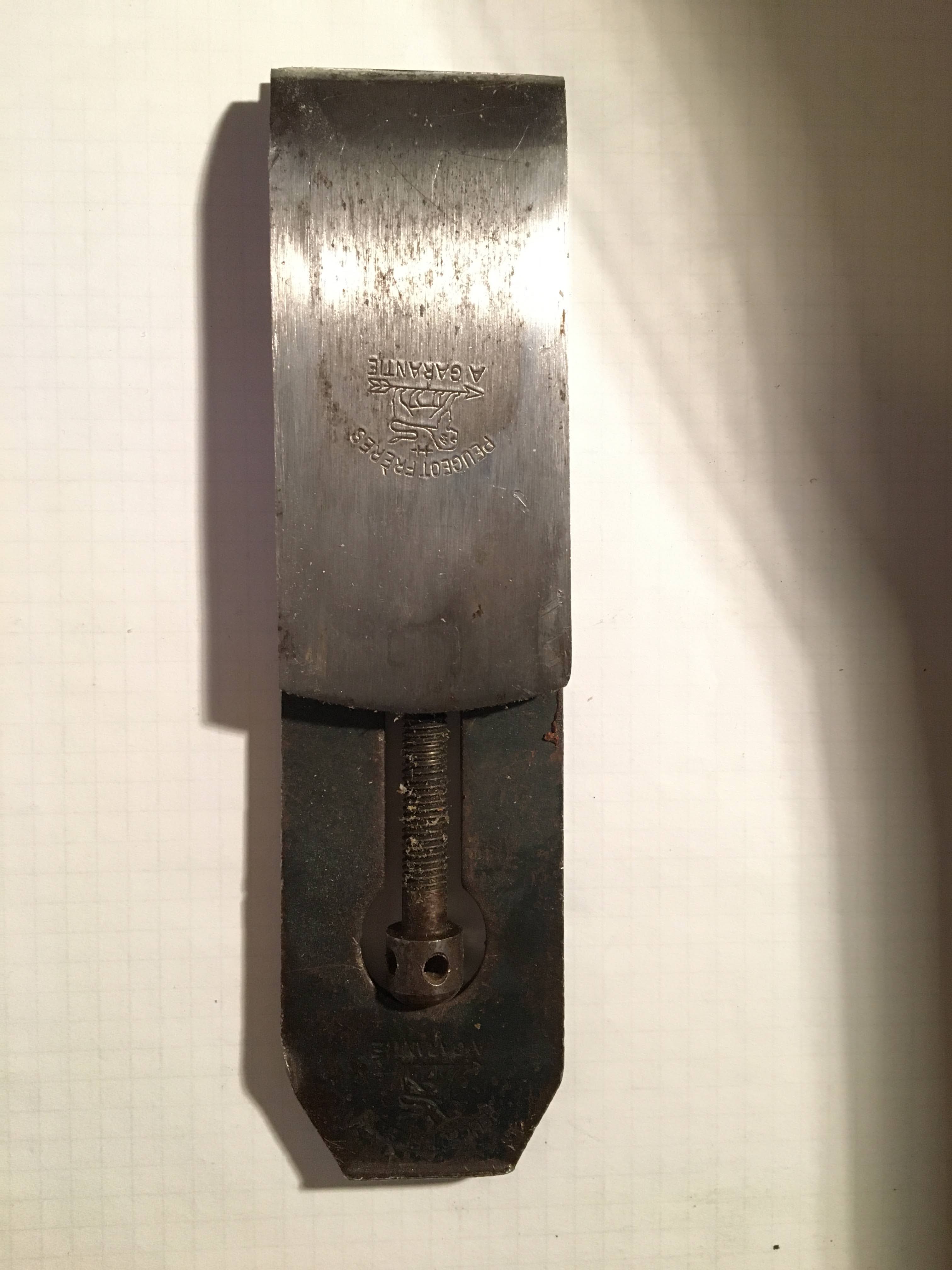
That plane has an interesting mechanism to set the chip breaker on the blade. A screw allows to move the chip breaker/blade up and down. The head of the screw goes onto a pin at the top of a slot in the blade.


Chip breaker mechanism
The screw head in the blade. The blade is
stamped Peugeot Freres Garantie.


The chip breaker shows some sign of rust.

Rusty chip breaker.

I cleaned it using my usual combination of polishing compound for silverware.

Chip breaker looking better now...
...and shiny.


The blade was totally dull and looked like having been ground but never honed. The grinding made a hollow on the blade bevel. I sharpened it starting with 220 grit, followed by 1000 and 4000 then up to 8000 grit. I finally used the leather strop for final mirror polishing.

The blade sharp and clean.

I did not clean the whole blade surface but only a third of the length on the bevel end.
I put back the blade and chip breaker assembly in the plane and after few adjustment the plane was ready for a test run.

Nice curly shavings.

This plane is truly a pleasure to use. I applied some beeswax to the sole and it is rubbing incredibly smoothly on wood.

Clean and back to work.

This plane will certainly be one of my favorite from now on, I really like the feeling of wood on wood and it is cutting the wood very nicely.


Monday, May 27, 2019

Vintage tools: Peugeot Frere 314 hand grinder

As mentioned in a previous post, I recently received an old hand grinder made by Peugeot Freres. Before starting with the restoration of this nice gift I wanted to know as much as possible about that grinder. After some research I found it in the catalog No 751 from Peugeot Freres.

Peugeot Freres, catalog No 751

The grinder appears at page 50 of the catalog.

Page 50 of the catalog.

The model I received is a model 314 "lion", described as ultra-robust, with an oil sump allowing for constant lubrication of the gears. The gear multiplication ratio is 1 to 10 and the wheel is made of superior vitrified corundum (that everybody know is a crystalline form of aluminium oxide of course) which is the second hardest mineral after diamonds (thank you Wikipedia).

The No 314 "Lion" grinder.

From the catalog I can trace the manufacturing of that tool back to 1951.

Now that I am a bit more familiar with the tools and that I know what is corundum I can start with the restoration of this little piece of history.

First thing was to give a good green slime bath to all the hardware like screws, handle, bolts etc. But before doing this, and based on my previous experience with the green slime, I need to first wear this:

Trying to avoid getting my hands colored in green for a week.

I put all the hardware in a plastic box and filled with the green slime.

Hardware bathing for 20 minutes or so.

After around 20 minutes these were ready to be brushed, rinsed with water and oiled a bit so not to rust again.

Hardware cleaned and oiled.

Next step was to do the same with the grinder body. The internal gears are in perfect shape and thanks to the oil that was applied to the interior part there is no any trace of rust so no need to bath everything, just the external part of the body needs to be cleaned a bit what took me multiple coats of green slime applied with a brush and a final brushing and rinsing.

Grinder body, cleaned from any rust.

When clean I was able to read the model number 314 at the bottom of the body.
I decided not to repaint the body  as I want to keep the original paint (well what is left of the original paint) and patina.

The wheel is in very good condition and barely shows any usage.

The grinder wheel, a bit dirty but in good condition.

I will keep it for now and will see if it is of any good usage, if not I will replace it with a brand new one.

Time now to get all pieces back together and look at the final result.

All pieces back together.
The sharpening guide in front of the wheel show 2 gutters used to sharpened drill bits at different angles using the side of the wheel.

The grinder set on a temporary place.
I will need to find a permanent place where to set this little gem and cannot wait to try it on some plane iron or chisel.