Monday, December 16, 2019

Some steps, some progress.

Continuing where I left on my TV stand project I needed to make some more tongue and grooves in order to join the shelves and the face frame. I dismantled the frame and used a 1/4" chisel to make the grooves.

Grooves at the rear of the face frame.

Here the grooves are stopped where there is some tenon joinery. I made tongues on the side panel in the same way.
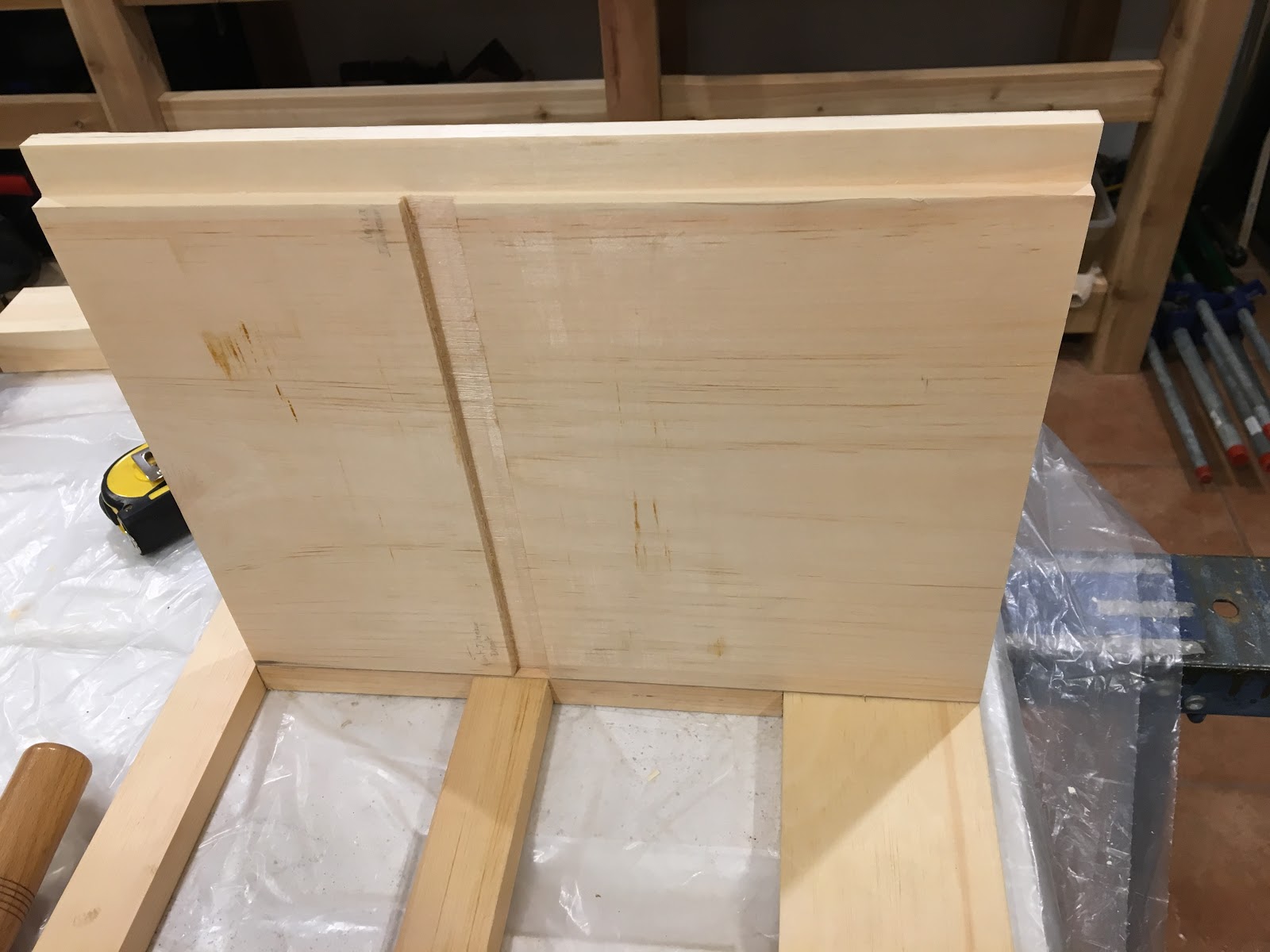
Side panel assembly.

I then did the same to the middle shelf and I was able to do a quick dry fit of the whole assembly.

A quick dry fit, view from the top...
...and from the bottom.

Next was to bore all the holes that will be used to reinforce the side and back with pegs. I first marked the hole centers.

Holes marked in the middle of a dado.

I then used an hand drill to make small pilot holes.
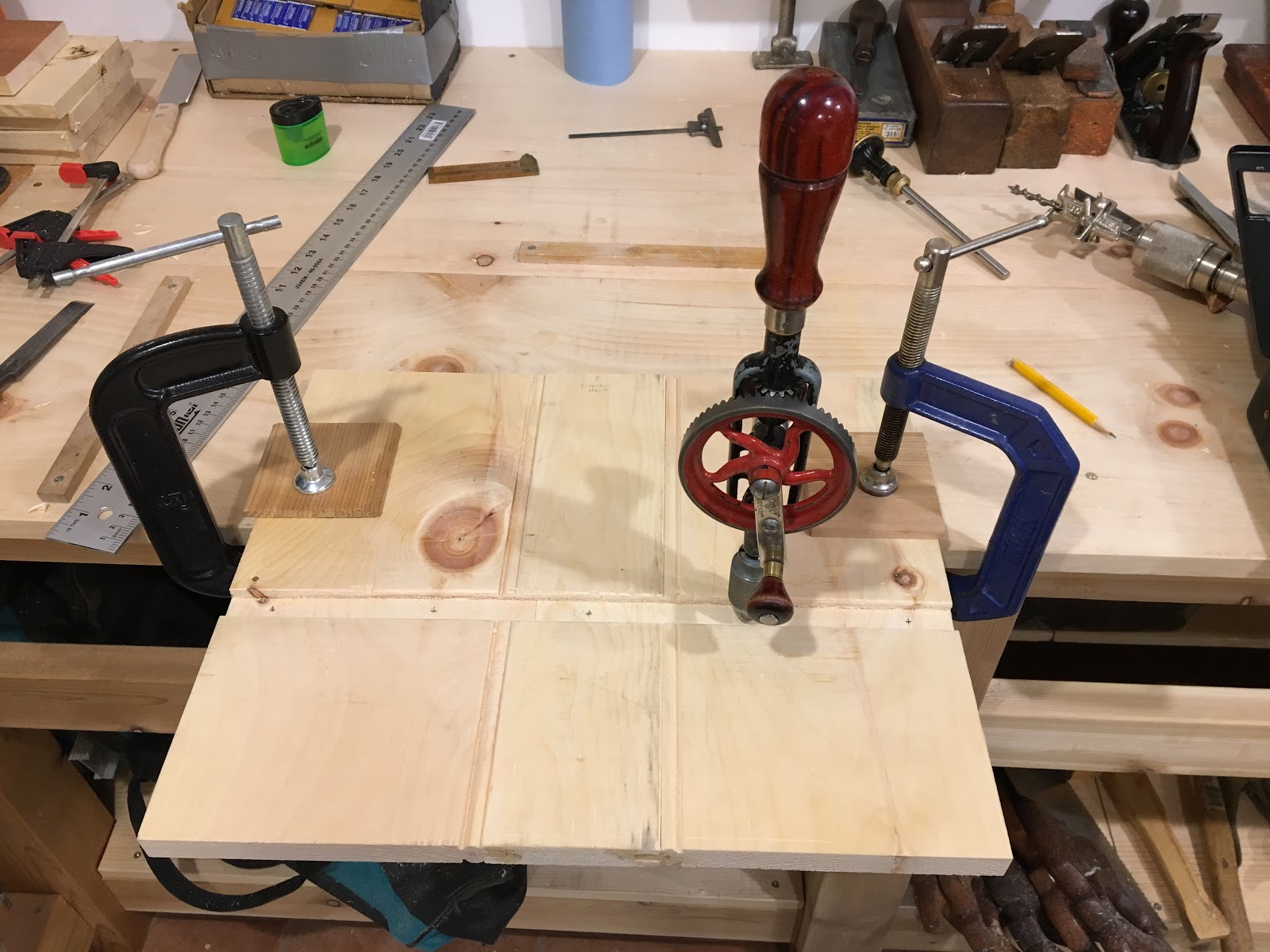
Making pilot holes.

I then used a hand brace to bore the peg holes.

Boring the peg holes.

I repeat this on all parts and called it done.
After having done most of the parts, I was able to clean some pieces and start the assembly. I began with the central muntins and rail.

Central muntins and rail glue up.

While the glue was drying, I took care of finishing the shelves interior. I used a shellac mix as a wash coat to try to avoid blushing. The mix is made of 1 part of amber shellac, 3 part of white shellac, the whole diluted 50/50 with alcohol.

My shellac mix used as a wash coat.

I mixed a part of amber shellac as after some trials I found out that it highlights a bit more the golden aspect of pine. Too much of amber shellac and the wood turns orange though. After light sanding I applied two coats of that mix. For each coat I brushed the shellac on then wiped it off so there is no build up.

Wash coat applied.

After leaving it to dry for the afternoon, I again sanded lightly with 220 grit and I applied the stain. The stain I used is made of natural components like nuts and is oil based.

The stain I used.

I initially used this for some floor made of larch wood and really like it. It does not smell anything else but nuts oil what I like very much. I applied the stain using a brush and left it dry 15 minutes.

Stain applied with a brush.

I then wiped it with a clean cloth.

Stain wiped off.

I like the result, not much blushing (but still a bit though maybe a third wash coat would help) and the final stain is exactly what I needed.
I left this to dry overnight. The day after I applied the first coat of finish. I was initially planning to use shellac for the finish but changed my mind (again) and will be using wiping varnish and wax.
I made my own wiping varnish by mixing oil based varnish, BLO and turpentine in equal part. I used a clean rag cloth rolled as a ball to apply it.

First coat of wiping varnish left to dry.

I will leave this to dry overnight before applying a second coat. For the shelves interior two coats will be enough as this will not be exposed much to sight.

While the wiping varnish was drying I tackled one of the last part I needed to make, the lower shelf.
The shelf will have a form similar to the top form. I marked the board and did a rough cut with the saw.

Lower shelf rough cut.

I then planed the cut clean and used a chisel to carve the curves.

Carving the curves.

When the whole profile was done I lightly sanded the round part. I then needed to plane a tongue where the shelf will be assembled on the face frame.

The tongue used to join the shelf with the face frame.
The final result.

Few things are left to be done and it will be mostly a matter of some adjustments, applying finish and glue everything in place.


Monday, December 9, 2019

A Range of Tongue and Groove Joinery.

Pursuing the work on my TV stand project, I had time during the weekend to work on the middle shelves section. This section will form a box with a middle shelf and a bottom board will close the box and be lower shelf. That box inner dimensions will be 10"1/2 deep, 14" high and 16" wide to be able to store a TV cable receiver and DVD player.
The first thing to tackle is to dimension the required pieces as follow:

  • 11"1/2x14" boards (2) as the two side panels.
  • 16"1/2x14 board as the back panel
  • 11"1/2x16"1/2 board for the middle shelf.

As I want a straight cut and the board is too wide to fit properly on my miter box, I set a fence using a scrap piece of wood and a clamp and used the long backsaw from the miter box to make the cut.

Using a fence to cut straight...
...and using the long backsaw.

I check the cut from squareness and cleaned the end grain using my low angle block plane.
 
Considering its dimensions, the back panel is made by assembling two 7"1/2 boards with a 3"1/2 board. The assembly is done using standard tongue and groove joinery, 1/2" deep, made using my Record 50. 
I started by making the tongues on each of the 7"1/2 boards.

Using the Record 50 to make tongues and grooves.

I then made the grooves on each side of the middle board and added side beads.

Dry fit of the back board assembly.

Next is to glue up the assembly. In theory I do not have to glue it as it will be seated between the two side panels but as the back panel will support the rear leg I prefer to glue it so to make it stronger.

Gluing the back board assembly.

This back panel will be set in a rabbet made at the rear of each side panels and the join will be reinforced with dowels. I used my Record 778 to make the rabbet on each side panels.

Using the Record 778 to make the rear rabbet in each side panels.

That plane is cutting very well and the fence having two rods it does not tend to move like is doing my Craftsman plane that have only one rod. I still need to practice though as I have the tendency to slightly shift down the plane on the left side resulting in a tilted rabbet.

The middle shelf will be set in a dado made in each side panels too. First I noticed that the shelf board is slightly cupped so I used my wooden Peugeot plane to get it back to flatness.

Using my wooden Peugeot plane to flatten the middle shelf.

This plane is truly amazing. It rides on wood so smoothly and its iron cut like nothing else. The board has a big knot on one side and this was nothing to plane. The iron cut through the knot as smoothly as through butter and without a hick up. 
Flattening the board reduced its thickness to 11/16 so I need to take this in account when making the dado.
I used a marking knife to mark where to make the dado on the side panels, then used a chisel to make a kerf on the inside face of the dado. I then used my Record 42 shoulder plane to start the dado cut while tilting it.

Using the Record 42 shoulder plane to start the dado cut.

When I reached the bottom on each face of the dado, I switched to my router plane to finish the cut.

Switching to the router plane to plane the dado's bottom flat.

Finally using a chisel I cleaned the corners and I was done.

A clean dado.

Time to try a dry fit of the shelf to check if I did it right (or wrong).

The shelf fit...


... pretty good fit.

That is all for today. Next will be to make tongues and groves so to assemble the box with the face frame, to drill the holes for the pegs and to assemble every pieces altogether.
I am thinking to first finish each piece before assembly as it would be easier to apply stain and shellac on each piece than on the fully assembled body. 
My plan for the finish is to apply and sand a coat of white shellac to seal the wood and prevent blotching, then a coat of stain, then few coat of shellac and finally to wax the whole to get a nice sheen. 


Wednesday, December 4, 2019

TV Stand

As Christmas is approaching fast, I need to tackle my TV stand gift for my sister in law.
I already jointed the boards needed to make the top. After having cleaned the glue a bit I traced the form that will be cut.

Top form marked with pencil.

It matches perfectly the full size plan I made before.

The plan match perfectly the trace.

I will need to cut the top as close to the line as possible so not to spend too much time cleaning the cut, but also not too close so not to risk any mess up. This will be an interesting moment!

But for now I will take care of the face frame assembly with front legs and shelf. I first need to cut two front legs, one apron, two muntins and two rails to the correct length.

Two legs...
...apron and bottom rail.


...and central muntins and rail.

The front frame will all be assembled using mortise and tenon joinery, so next step is to cut all tenons. After having marked and sawed the tenons I am using a router plane to bring them back to exact size.

Using the router plane to finalize tenon shaping.

After each pass with the router I am checking the depth of the cut using a combination square set to the correct depth.

Not quite yet...

If the depth is not correct I then increase the router depth by half a turn on the depth adjustment wheel.

Here we are.
Tenon sized to the right thickness (1/4 of an inch)

After a while the tenons are done. The router plane really makes the tenon cleaning an easy thing.

A bunch of clean tenons.

At the end the central part of the face frame will be assembled like this.

How the central pieces will be assembled.

Now that the tenons are done, I need to carve as many mortises as needed. Considering the small size of the mortise, I did them directly by hand using chisels, I did not bore the waste first.

Mortise in the leg top.

This is quite easy in soft wood like pine, just need the chisels to be sharp enough (and not more).
After all mortises were done on each piece time has come for a dry fit of the face frame.

Face frame dry fit, looks good to me.

Next step is to tackle the central box and shelf, stay tuned.


Monday, December 2, 2019

Peugeot Freres Plane

A while ago my father brought me a Peugeot Freres plane from France that I did not restored yet, well until this last weekend.

Peugeot Freres plane.

This plane is made of Cormier wood (Sorbus Domestica) and it is stamped on the plane. From the stamp on one side of the plane this is a 48mm plane.

Peugeot Freres stamp on the plane nose with 48 indicating
the width in mm.

The plane sole is in perfect shape.

The sole has no damage and is straight and flat.

That plane has an interesting mechanism to set the chip breaker on the blade. A screw allows to move the chip breaker/blade up and down. The head of the screw goes onto a pin at the top of a slot in the blade.


Chip breaker mechanism
The screw head in the blade. The blade is
stamped Peugeot Freres Garantie.


The chip breaker shows some sign of rust.

Rusty chip breaker.

I cleaned it using my usual combination of polishing compound for silverware.

Chip breaker looking better now...
...and shiny.


The blade was totally dull and looked like having been ground but never honed. The grinding made a hollow on the blade bevel. I sharpened it starting with 220 grit, followed by 1000 and 4000 then up to 8000 grit. I finally used the leather strop for final mirror polishing.

The blade sharp and clean.

I did not clean the whole blade surface but only a third of the length on the bevel end.
I put back the blade and chip breaker assembly in the plane and after few adjustment the plane was ready for a test run.

Nice curly shavings.

This plane is truly a pleasure to use. I applied some beeswax to the sole and it is rubbing incredibly smoothly on wood.

Clean and back to work.

This plane will certainly be one of my favorite from now on, I really like the feeling of wood on wood and it is cutting the wood very nicely.